The Turnstile Before the Ticket Scanner
The turnstile before the ticket scanner shows how an entrance can separate ticket checks from passage and help visitors understand the route inside.
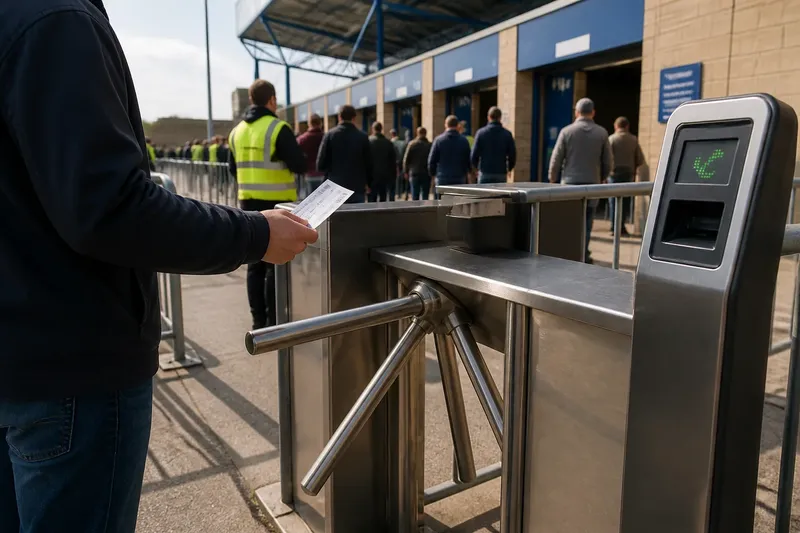
What does a turnstile do when a scanner handles the ticket? The turnstile before the ticket scanner helps separate the decision to admit someone from the physical act of entering. Its arms mark a threshold, meter passage through a defined opening, and make the next movement easier to read.
A threshold with a rhythm
Imagine a hypothetical ground with a broad entrance court, a narrow passage, and a busy stand beyond it. A ticket checker can inspect a paper ticket at the opening, but a crowd may still press toward a gap whose flow is difficult to regulate. A turnstile shapes the passage by allowing people through in a limited sequence, according to its design.
The mechanism does not simply block people. Its rotating arms yield as someone passes, then occupy the opening again. That repeated movement creates a legible sequence: approach, pause, pass through, clear the threshold. For spectators, entry becomes a series of distinct passages rather than one undifferentiated surge.
A turnstile also makes the boundary of an entrance visible. Unlike an open gate, it signals that passage happens through a particular channel and at a controlled pace. That spatial role can remain even when another device handles admission.
Counting through movement
A turnstile can be linked to a counter that records passages through that point. The count has limits: staff still need to check admission, manage exceptions, and know which entrance serves which area. The mechanism makes movement countable; by itself, it does not establish that each person has the right ticket.
A ticket scanner handles a different task. It reads a credential and registers whether it has been accepted, while the turnstile controls the physical opening. In some arrangements, a successful scan releases a barrier and staff assist with a failed read, an accessibility need, or a ticket that requires attention.
So where does permission become passage? The answer depends on the layout. A staff member may check a ticket before a turnstile, a scanner may sit beside the barrier, or staff may operate a gate for a particular group. Clear signs and a visible route help spectators understand what to do next.
One invented arrival
Say you are approaching a hypothetical ground with a paper ticket for a particular stand. A steward points you toward the correct bank of turnstiles. You join the queue, present the ticket to a checker, and move through when the rotating arms are clear.
Beyond the passage, signs identify the stand and the route to its seating blocks. The expected observable result is that each person passes through a defined opening, while the group enters in a more distributed flow than it would through a single unregulated gap.
Now imagine the same invented arrival with a scanner at each turnstile. You hold the ticket where the reader can see it; if the scan is accepted, the barrier releases. The turnstile still shapes the pace and defines the threshold, while the scanner handles the ticket decision. A clear sign or a steward remains useful when someone is unsure which entrance to use.
What the mechanism cannot do
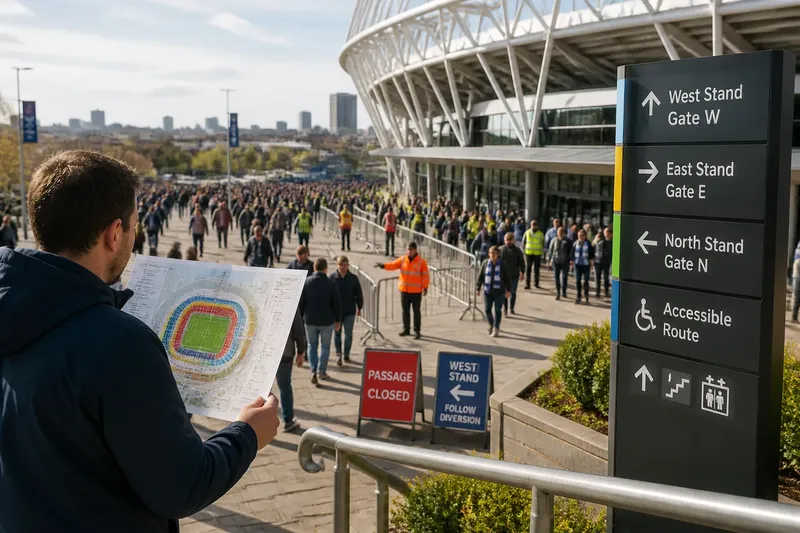
A turnstile meters one opening, not the entire journey to a seat. If spectators leave the passage and meet a narrow concourse, a blocked stair, or unclear signs, the controlled entry may simply shift the point of congestion. The device works as part of a route that gives people room to pause, orient themselves, and continue.
It also does not make every entrance suitable for every visitor. A rotating barrier may be difficult for someone using a mobility aid, carrying equipment, or needing more time to pass. Look for venue information about an accessible or assisted route, and ask staff if its location is unclear.
What is not worth the effort is treating the turnstile as a complete crowd-management solution or expecting visitors to infer the right queue from the hardware alone. The approach, signs, staff position, and route beyond the barrier all shape how orderly an entrance feels.
Questions about turnstiles?
Why are turnstiles used at stadiums?
They define an opening and can regulate the pace of passage through it. If connected to a counter or admission system, they can also help record movement at that entrance.
Did turnstiles check tickets?
A turnstile is a physical barrier, not a ticket reader. A person, ticket mechanism, or scanner handles the admission decision while the barrier controls passage.
Are turnstiles still used with scanners?
A scanner can authorize entry while a turnstile or another barrier controls the opening. The arrangement separates the ticket decision from movement through the threshold.
What happens if a ticket will not scan?
Follow the venue’s signs and ask nearby staff for help rather than trying to force the barrier. Staff can direct you to an assistance point or another appropriate entrance.
The entrance as a cue
The turnstile before the ticket scanner is a useful way to understand how a stadium entrance separates admission from movement. The scanner may change how a ticket is checked, but the turnstile still marks a boundary and gives passage a visible pace.
As you approach, notice which queue serves your ticket, where staff can help, and what route opens beyond the barrier. Those cues reveal whether the entrance is only a checkpoint or the start of a clear path into the ground.