Why Stadium Entrances Often Divide Arrival Into Stages
Stadium entrances divide arrival into stages so you can find the right approach, cross the threshold, and choose an internal route with less confusion.

Why do stadium entrances divide arrival into stages instead of sending everyone straight to a door? A stadium entrance is often a sequence: an outer approach that helps you identify where to go, a threshold that manages entry, and an internal route that carries you toward a stand or facility. Each part answers a different question, and understanding the sequence can make arrival less confusing even when a venue’s layout differs from the one you expect.
Three arrival questions
Before reaching the venue, you need to locate the right side of the building or site. At the threshold, you need to know whether you are at the entrance intended for your ticket or access needs. Once inside, you need to orient yourself toward the next destination. A single doorway can sit at the end of all three decisions, but it cannot make those decisions disappear.
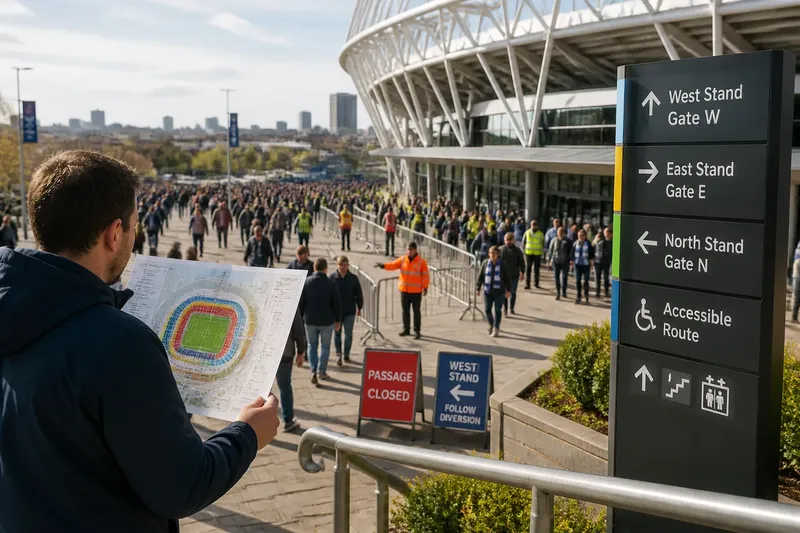
Separating them gives each part of the approach a more legible job. A sign or landmark on the outer approach can identify a gate; a staffed or controlled threshold can confirm entry; and a concourse sign can point toward a section. These elements need not be arranged as three grand architectural features. In a compact ground, the stages may be close together; at a larger venue, they may be spread across the site.
The distinction matters because “the entrance” can mean different things to different people. A visitor may mean the public-facing gate, while a ticket may name a particular entry point and the stand has its own internal access. Treating these as separate locations helps explain why reaching the stadium perimeter does not always mean reaching the correct door.
Open approach, clear threshold
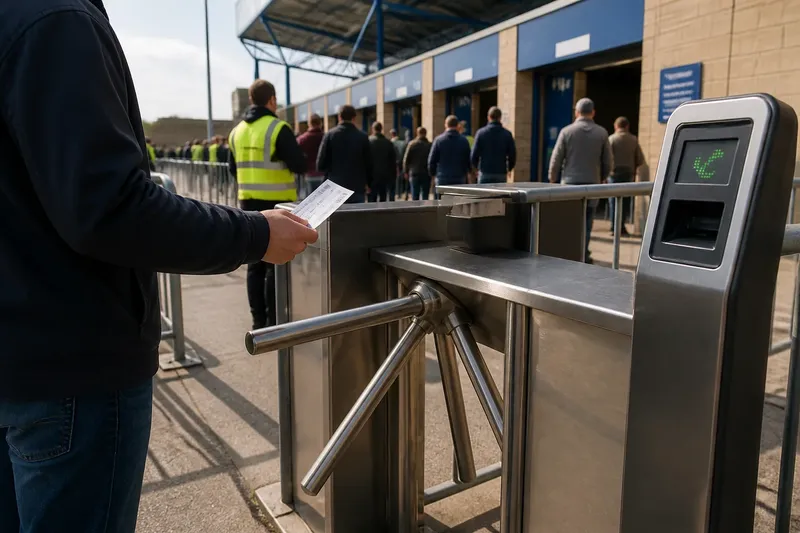
One common approach gives the outer arrival area room to absorb people before they reach a defined threshold. The approach may include a forecourt, a broad path, a plaza, or simply a stretch of pavement with directional signs. The threshold may then be a gate, a turnstile line, a staffed entrance, or another clearly marked point where entry is checked.
This arrangement can suit venues with several gates or groups arriving from different directions. It allows visitors to identify their entrance before joining the immediate entry flow, and it gives signs more than one opportunity to clarify direction. The trade-off is that an open approach can leave newcomers unsure which side to use if gate names, ticket information, or signs are hard to connect.
In this arrangement, a landmark can do useful work before a sign is close enough to read. A visible corner, stand name, or distinctive canopy can help a visitor establish where they are, while gate lettering confirms the final choice. The landmark should orient rather than replace the directions: knowing the north side of a venue is less useful if a ticket directs you to a named gate on another side.
Compact entry sequences
Another approach places the threshold close to the outer edge, then uses the interior to distribute visitors. A modest exterior entrance may open onto a concourse, lobby, or covered circulation space with signs to stands and facilities. This can suit a venue with a clear front door, limited perimeter space, or an internal layout that provides the main choice of route.
Its main demand is a prompt, readable decision once inside. If visitors emerge into a space with several corridors, stairways, or branching concourses, they need to identify their next route without blocking the entry point. Stand names, section labels, and consistent directional arrows can make the transition clearer; a sign that only repeats the venue name does little once the visitor is already inside.
A compact sequence can also be less intuitive when several entrances lead into different parts of the same interior. The visitor may enter successfully but still need to cross a concourse or change levels to reach a seat. For this approach, the useful question is not simply “Where is the door?” but “What will I see immediately after I pass through it?”
Choosing by arrival
The better arrangement depends on what kind of arrival decision is hardest for you. If you are unfamiliar with the site or approaching from a busy street, a legible outer approach and visible gate identification may matter most. If you already know the correct entrance but expect to make several choices inside, clear internal signs and recognizable concourse landmarks may matter more.
- Look at the ticket wording. Note whether it names a gate, stand, section, or entrance type; these labels may refer to different points in the sequence.
- Check the venue’s arrival directions. See whether they distinguish the site approach from the entry point and the route to your seating area.
- Consider your approach direction. A gate that is easy to spot from one street or transport stop may not be visible from another side.
- Allow for the first decision inside. Identify whether you will need to choose a level, concourse, or stand after entry.
- Account for access needs. Look for the designated accessible approach or entry information rather than assuming that the nearest door serves every visitor.
Say you have a ticket naming a particular stand, and you are arriving on foot from a station on the far side of the venue. You check the venue directions and see that the stand’s gate is reached around the perimeter, rather than through the nearest visible entrance. Choosing that route before arrival should make the gate easier to identify and spare you an unnecessary interior detour.
It is not worth trying to memorize every corridor or entrance on a venue plan if your ticket and arrival directions already identify the relevant gate and stand. A simple mental sequence—approach, threshold, interior route—is usually more useful than a complete catalogue of doors.
When do I choose a gate?
Does the nearest entrance suit my ticket?
Not necessarily. A nearby entrance may serve another stand, a different ticket area, or a specific access route, so compare the ticket’s wording with the venue’s directions before setting off.
Why is my seat not beside the gate?
The entrance brings visitors into the venue; it does not have to open next to every seating section. An internal concourse or stairway may connect the gate to the stand shown on your ticket.
What if signs point in different directions?
Pause somewhere clear of the main flow and compare the sign with your ticket or the venue’s official directions. If the labels still do not match, ask a steward rather than guessing at a restricted or one-way route.
How do accessible entrances fit the sequence?
An accessible arrival may use a different outer approach, threshold, or internal route from the general entrance. Check the venue’s specific access information in advance, and ask staff for direction if the route is unclear on arrival.
Read the sequence
Stadium entrances divide arrival into stages because finding the venue, entering it, and moving toward a destination are distinct tasks. Some grounds make the outer approach the clearest part; others rely on a compact entrance followed by strong internal wayfinding. Reading the sequence against your own ticket and approach gives you a practical way to choose where to head first, without assuming every stadium uses the same arrangement.
When local entry rules, ticket conditions, or access arrangements affect your route, follow the venue’s current instructions; these can differ between events at the same ground. On arrival, keep your ticket accessible and look for the next decision point rather than treating the first visible door as the whole journey.